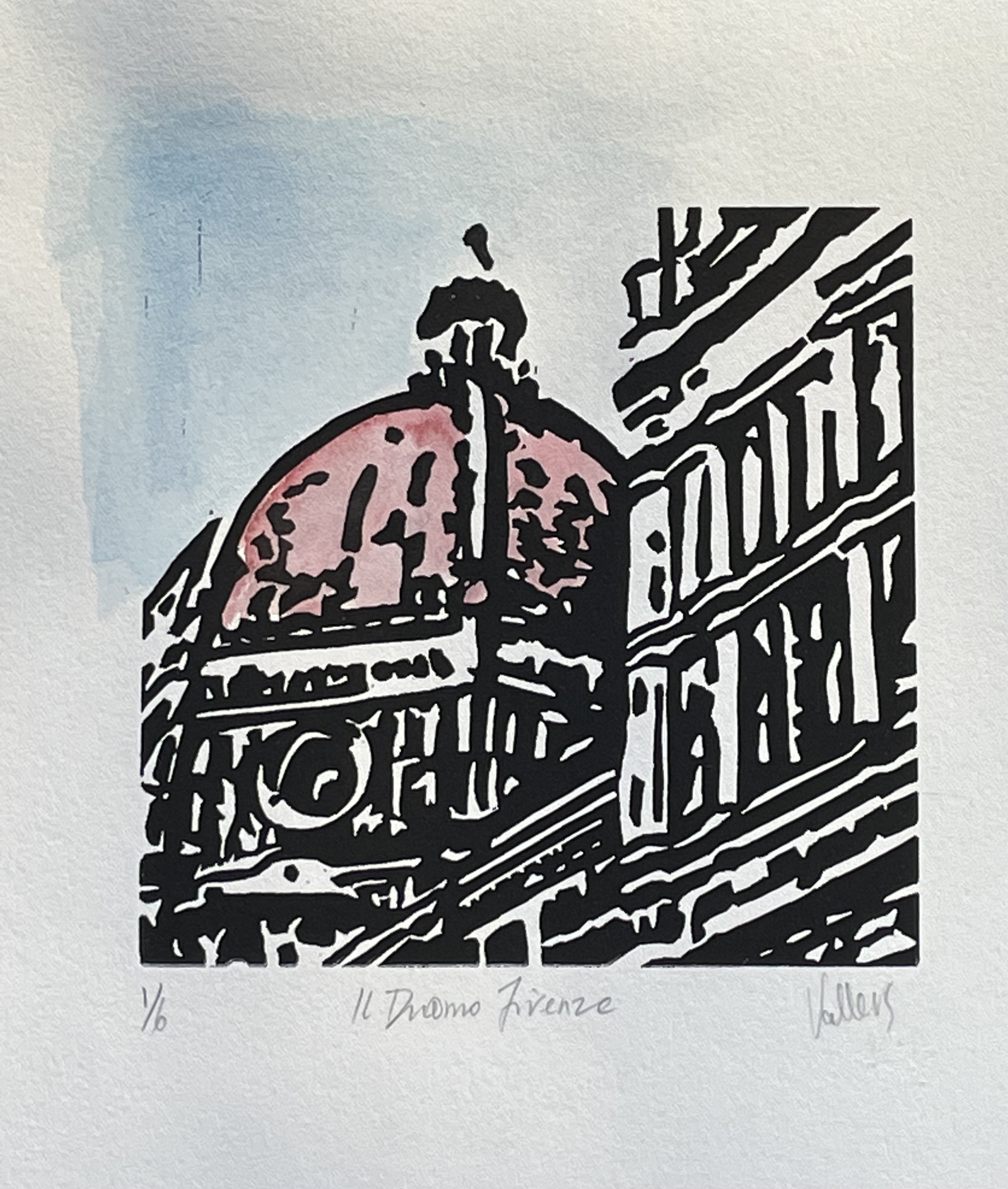
As I was trawling through the google machine looking for something for my students, I came across, and was intrigued by, an article that asked a very interesting question: What Do We ‘Express’ When We Express Ourselves Through Art? It actually made me stop and think…..what am I trying to ‘say’ when I create my work? I had always found that really difficult to articulate. I know that I love to draw and create lino prints and I get a lot of enjoyment from the creative process of carving the lino block, for instance. Is it enough to simply enjoy the process in which you are immersed without having to think about what you are trying to ‘express’ through the work as well? Should there be more? Was there a need for deep and meaningful messages to always be present in artwork? Or is that something that happens from the viewers perspective depending on what they glean from viewing the work and how they connect with it?
The article, by Christopher P Jones, focuses on the idea or assumption that artists ‘express themselves’ through their artwork as well as the assumption that artists put ‘something of themselves’ into their creations.
As the article rightly points out, ‘the assumption appears everywhere, in the language spoken in art galleries, exhibition reviews, art biographies and in everyday conversations around art.’ One would be quite within their rights to feel they were being ‘railroaded’ into creating a story around their creative practice in order to simply appease others and their idea of artists and artistic expression.
Many of the artists we know have created a trail of evidence that allows us an insight into what they were thinking, feeling or even experiencing at that time in their lives. This in turn helps us to understand why particular works were created and what that artist was trying to ‘express’ through their work. But how can we know what expressive intentions an artist has if instead we know nothing about them? If we think about artists like Vermeer, for instance, where next to nothing is really known about him, we can only guess what his intention might have been largely based on the time period and cultural norms in which the work was created.
Reading on in this same article, I am presented with a quote from Matisse:
‘Expression to my way of thinking does not consist of the passion mirrored upon a human face or betrayed by a violent gesture. The whole arrangement of my picture is expressive.’
……and from the author of the article:
‘I think a better approach to reading a work of art, as indicated by Matisse’s words, is to not consider it as corresponding to an emotional state within the artist, but rather as an inclination or thought that is realised — formed and made concrete — in the actual making of the work itself. It is the urge to make something that is what is expressed in the work.’
….and this immediately resonated with me. This is me! I have an urge to create. I love the act of creating and sharing what I create. It brings me joy.
So, if we use this as the premise for artistic expression, essentially, what I ‘express’ in my work is my preference for working with lino and being immersed in the printmaking process of drawing, carving and printing images. Through my art making and choice of imagery or subject, I also express my preference for the structured and orderly linear qualities that lino printing offers, whilst portraying the renaissance architecture of the world cities or locations that I have visited and connected with, and my love of colour through its limited use to create a focal point that allows the viewer to immediately recognise a well known landmark that may in turn create an emotional connection for them. What you see before you is my treatment of the subject: my ‘expression.’ That is ’me.’
Finally, going back to my first paragraph, I do sincerely believe that whilst I have certain ideas about my own work and there is usually good reasons why I create what I do and what they mean to me, at the end of the day, everyone comes to an artwork with their own life experiences and these will always influence the way you connect (or not) with a work and what ‘messages’ come to you as you view the work. That’s how it should be.
 Printed by Vallers
Leave a comment